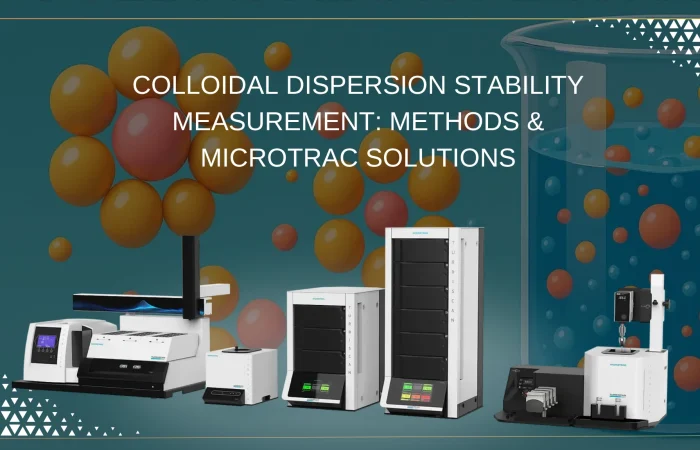
Colloidal Dispersion Stability Measurement: Methods & Microtrac Solutions
Everyday products we rely on, from milk and sunscreen to paints and medicines, are built on colloidal dispersions. But what does colloidal mean in this context? In simple terms, a colloidal dispersion is a system where small particles of one substance are evenly distributed in another, creating what scientists call a colloidal system.
To define a colloid, think of particles ranging between 1 nanometer and 1 micron in size, suspended in a continuous phase. These particles can be solid, liquid, or even gas, dispersed in another medium. Depending on the combination, common examples of colloidal dispersions include:
- Suspensions like pharmaceutical syrups
- Emulsions such as lotions and creams
- Foams like whipped foods and shaving gels
- Aerosols, including sprays and inhalers
So, what is colloidal stability, and why does it matter? Stability determines whether these systems maintain their properties over time or break down into separate phases. In industries where safety, performance, and shelf life are critical, understanding and measuring stability is essential for product success.
Understanding Colloidal Dispersions
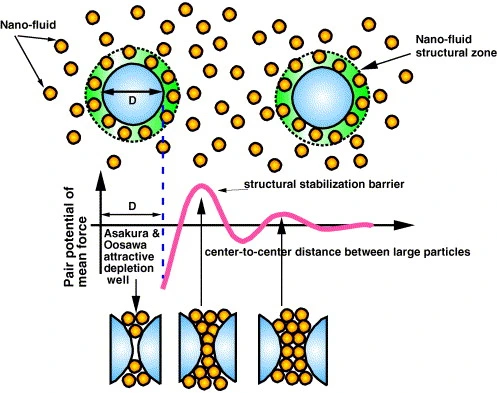
Source: ScianceDirect
To fully grasp the colloidal meaning, it helps to look at what makes these systems unique. A colloidal dispersion contains particles between 1 nanometer and 1 micron in size. These particles are small enough to stay suspended for long periods but large enough to scatter light, a property that distinguishes colloids from true solutions.
By definition, a colloidal system is thermodynamically unstable. Given enough time or the wrong conditions, particles will eventually aggregate, separate, or settle. This instability doesn’t mean colloids are unusable, in fact, they’re the basis for countless industrial and consumer products. Instead, it highlights the importance of monitoring how dispersions behave under real conditions.
Different processes drive this instability. Some cause particles to clump together (aggregation or agglomeration), while others cause them to move within the medium (sedimentation or creaming). Distinguishing between these mechanisms is crucial, since a formulation can be colloidally stable but gravitationally unstable, or vice versa.
Understanding these dynamics is the first step toward choosing the right measurement techniques and ensuring reliable performance in practical applications.
Two Key Stability Categories
When evaluating a colloidal dispersion, it’s important to separate two distinct forms of stability: colloidal stability and gravitational stability. Although they are related, they arise from different mechanisms.
1. Colloidal Stability
Colloidal stability describes how well particles resist aggregation or agglomeration. If particle size remains unchanged over time, the system can be considered colloidally stable.
Forces influencing colloidal stability include:
- Van der Waals attraction and electrostatic repulsion, explained by DLVO theory
- Steric interactions, when polymers or surfactants adsorb onto particle surfaces
- Hydrophobic effects, which encourage particles to cluster in aqueous media
When these forces are balanced, dispersions maintain their structure, leading to longer shelf life and better product performance.
2. Gravitational Stability
Gravitational stability, on the other hand, refers to whether particles remain evenly distributed without migrating due to density differences. Processes like sedimentation (particles sinking) or creaming (particles rising) depend on particle size, density, and rheological properties of the medium.
According to Stokes’ law, larger or denser particles move faster in diluted systems. However, gravitational instability does not always mean colloidal instability. A system may be colloidally stable (particles don’t aggregate) but still gravitationally unstable if separation occurs over time.
Recognizing this distinction is key to designing formulations that remain both functionally and visually stable.
Techniques To Measure the Stability Of Colloidal Dispersions
Evaluating the stability of a colloidal system requires methods that capture both particle interactions and bulk behavior. Each technique contributes unique insights into colloidal stability and gravitational stability, making the right choice crucial for accurate results.
Electrophoretic Light Scattering (ELS)
ELS measures the zeta potential, a key factor in predicting whether particles repel or aggregate. High absolute values generally indicate stronger repulsion forces and greater stability.
- Useful for charged nanoparticle suspensions and emulsions
- Helps anticipate aggregation risks early in formulation
- Does not account for steric or hydrophobic stabilization
Dynamic Light Scattering (DLS)
DLS monitors Brownian motion to calculate the hydrodynamic diameter of particles. It is especially sensitive to early changes in particle size distribution.
- Detects aggregation before it becomes visible
- Effective for tracking nano- and microscale dispersions
- Less reliable for highly polydisperse or complex mixtures
Laser Diffraction
Laser diffraction offers a broad particle size range, from nanometers to millimeters, making it practical for polydisperse colloidal dispersions used in industrial applications.
- Provides quick, volume-weighted size distributions
- Ideal for monitoring paints, coatings, or food emulsions
- Not as sensitive to small nanoscale changes as DLS
Turbidity and Sedimentation Tests
These are traditional, low-cost methods where stability is judged by observing clarity, settling, or phase separation. While simple, they provide limited accuracy.
- Fast and inexpensive for routine checks
- Useful for spotting visible separation or cloudiness
- Too subjective for predicting long-term colloidal stability
Static Multiple Light Scattering (SMLS)
SMLS measures dispersions in their native state without modification.
- Tracks both particle size changes and migration in real time
- Provides quantitative monitoring much faster than traditional methods
- Preserves sample integrity for accurate, representative results
Together, these methods provide a toolkit for understanding dispersion behavior, but advanced techniques like SMLS deliver the most comprehensive and reliable view of colloidal stability
Microtrac’s Advanced Stability Solutions
While many techniques provide partial insights into dispersion behavior, Microtrac’s portfolio is designed to deliver a full picture of both colloidal stability and gravitational stability. At the core of this offering is the Turbiscan series, powered by Static Multiple Light Scattering (SMLS).
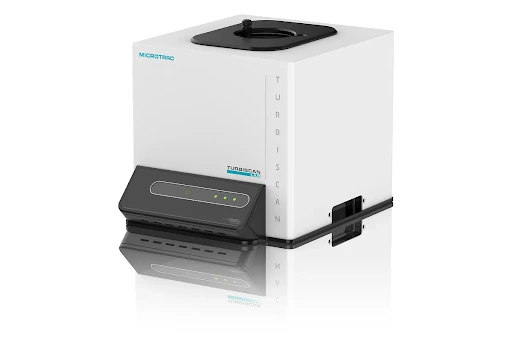
Buy Microtrac’s Turbiscan Stability Analyzer with professional consultation and equipment financing today!
With Turbiscan instruments, laboratories can:
- Analyze both aggregation and particle migration in a single test
- Obtain results up to 1,000× faster than traditional sedimentation or turbidity methods
- Work with samples in their native state, avoiding dilution or preparation steps that alter results
- Generate clear, quantitative data for comparison across multiple formulations
Beyond SMLS, Microtrac also provides a full range of particle size analysis technologies, including DLS, ELS, and laser diffraction, ensuring researchers can select the right approach for each colloidal system. This flexibility makes it possible to study everything from nanoscale suspensions to large, polydisperse dispersions.
By combining precision, speed, and adaptability, Microtrac instruments give R&D and QC teams the confidence to design products with proven stability and longer shelf life.
Practical Applications Across Sectors
The value of accurate stability testing becomes clear when looking at how colloidal dispersions underpin products across industries.
Industry | Examples of Colloidal Dispersions | Why Stability Matters |
|---|---|---|
Pharmaceuticals & Biotech | Oral suspensions, injectables, nanoparticle drug delivery | Ensures compounds remain potent, safe, and suitable for pharmaceutical formulations |
Food & Beverage | Emulsions in sauces, foams in dairy, fortified beverages | Maintains texture, taste, nutrition, and consistent shelf life |
Cosmetics | Creams, lotions, sprays (emulsions, suspensions) | Prevents separation or degradation while preserving performance and appearance |
Chemicals & Coatings | Paints, inks, industrial coatings | Guarantees uniform application, color consistency, and durability |
Nanomaterials, Clays & Batteries | Nanoparticle suspensions, conductive dispersions | Protects advanced functions where even minor instability affects performance |
Reliable analysis across these sectors allows companies to design safer, higher-quality products and shorten the path from development to market.
Why Choose Additive Plus For Particle Analysis Solutions
Reliable stability testing starts with the right tools, but choosing them can be challenging.
At Additive Plus, we simplify the process by offering a wide range of particle analysis instruments from trusted brands like Microtrac, designed to measure both colloidal stability and gravitational stability with accuracy.
Our team provides expert consultation to match your application with the right solution, whether you’re working in pharmaceuticals, food, cosmetics, or advanced materials.
To make adoption easier, we also offer flexible equipment financing, ensuring you can access the technology you need without delaying critical projects.
By partnering with Additive Plus, you gain more than instruments, you gain a long-term resource for improving product performance, extending shelf life, and accelerating innovation.
FAQ
How do scientists define colloidal systems?
To define colloidal systems, scientists describe them as mixtures where one substance’s tiny particles (1 nm–1 µm) are dispersed in another. Unlike true solutions, they scatter light and may be thermodynamically unstable, requiring stability analysis to predict long-term performance.
What is a colloidal in everyday terms?
When asked what a colloidal is, think of products like milk, paint, or lotion. They’re everyday examples of particles suspended in a medium. Their properties depend on both particle interactions and environmental conditions, which is why monitoring colloidal stability is so important.
What does the colloidal definition cover in science?
The colloidal definition in science includes dispersions made of solid, liquid, or gas particles spread evenly in another continuous phase. This broad definition covers suspensions, emulsions, foams, and aerosols, all of which require proper testing to confirm their stability and shelf life.
Can colloidal dispersions be both useful and unstable?
Yes. Even though colloidal systems are thermodynamically unstable, they are highly valuable across industries. With the right stabilizers and analysis, products like pharmaceuticals, foods, or cosmetics can remain effective, safe, and visually consistent throughout their intended shelf life.
Why does colloidal stability matter in industry?
Colloidal stability ensures products maintain their texture, safety, and function during storage and use. Without stability, dispersions can separate or lose effectiveness. Reliable testing methods, such as SMLS, help manufacturers guarantee product quality while reducing waste and development risks.
Explore What’s New in 3D Printing
How to Clean a 3D Printer Nozzle: Easy Steps for Optimal Performance
Can You 3D Print Metal? A Comprehensive Guide to Metal 3D Printing Technologies
3D Printing for the Medical Industry: A Review of Essential Technologies and Trends
How Long Do Resin 3D Prints Last? Factors Affecting Durability and Longevity in 3D Printing
How Can LFAM Boost Efficiency and Flexibility in the Automotive Industry?
Related Posts

Particle size distribution is a critical measurement for understanding and controlling how materials perform. It…