Struggling with aligning your 3D printed parts? This guide offers step-by-step instructions, tips, and techniques to ensure accurate, seamless fitment every time.
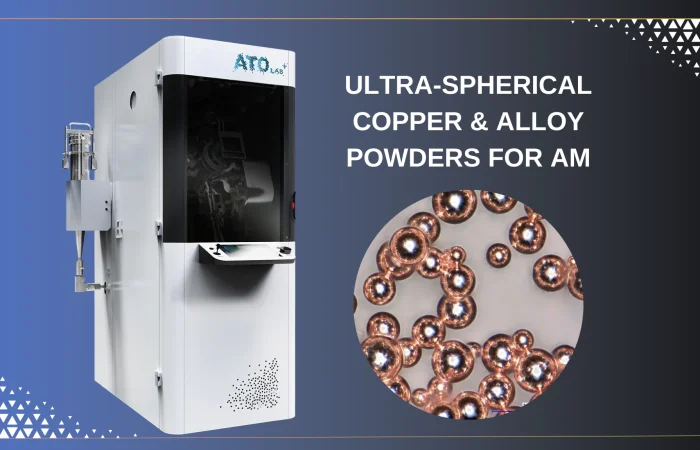
Ultra-Spherical Copper & Alloy Powders for AM | Optimized Ultrasonic Atomization Process
5.
Ultra-Spherical Copper & Alloy Powders for AM | Optimized Ultrasonic Atomization Process
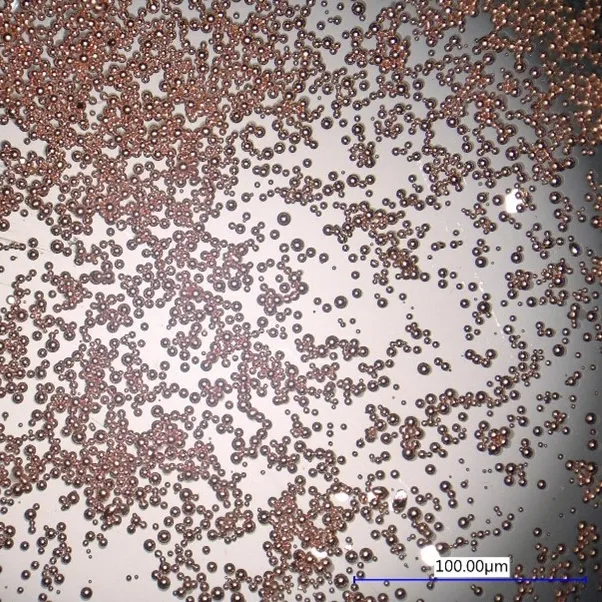
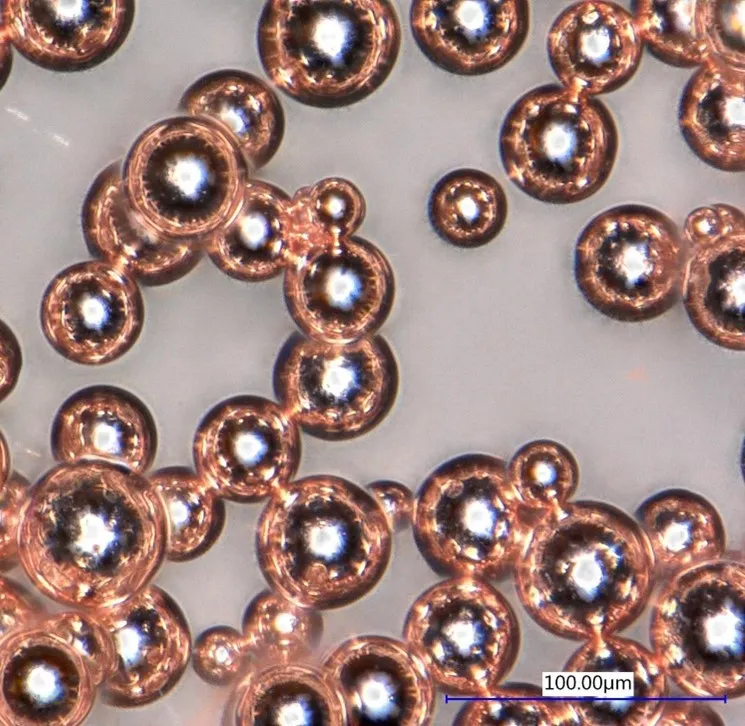
In the latest case study, 3DLab explores the optimization of ultrasonic atomization for pure copper and copper alloys, a critical advancement for additive manufacturing (AM) applications. R&D efforts focused on refining the atomization process to achieve high yields of perfectly spherical powders, ensuring superior performance in 3D printing, laser sintering, and other AM technologies.
Innovative Induction Melting & Ultrasonic Atomization
To transform copper scrap from production processes into high-quality powder, 3DLab utilized the proprietary induction melting system. This cutting-edge module leverages magnetic induction to melt the metal efficiently. By carefully controlling chamber pressure differentials, precisely dosed molten copper onto an ultrasonic atomization platform, where high-frequency vibrations generated uniform, spherical metal powders.
Process Optimization for Industrial Scalability
The research identifies key process optimizations that enhance atomization efficiency, yield, and powder quality. These advancements include:
Precision temperature & pressure control for consistent melt flow
Ultrasonic frequency tuning to minimize satellite particles
Real-time monitoring for improved powder sphericity and size distribution
These innovations ensure reliable, repeatable results, making ultrasonic atomization a viable solution for industrial-scale additive manufacturing.
Copper: Key Properties & Industrial Applications in Additive Manufacturing
Why Copper? Unmatched Conductivity, Durability & Machinability
Copper stands out as a critical material in advanced manufacturing due to its exceptional properties:
Thermal Conductivity (400 W/(m·K)) – Ideal for heat dissipation in high-performance systems.
Electrical Conductivity (58 × 10⁶ S/m) – Surpasses most metals, making it essential for electronics.
Corrosion Resistance – Maintains performance in harsh environments.
Excellent Machinability – Easily processed into complex components.
These characteristics make copper and its alloys indispensable across industries—particularly in additive manufacturing (AM), where high-purity powders are in demand.
Industrial Applications of Copper: From Aerospace to Electronics
1. Aerospace & Defense
Copper’s thermal management capabilities are vital for:
Heat exchangers
Avionic cooling systems
High-conductivity wiring
2. Automotive Industry
Electric vehicles (EVs) and traditional autos rely on copper for:
High-efficiency motors & inverters
Battery connectors & charging systems
Sensor and ECU components
3. Electronics & Semiconductor Manufacturing
As the backbone of modern circuitry, copper enables:
PCB (printed circuit board) traces
EMI shielding
High-speed data transmission lines
4. Construction & Energy
Copper’s durability and conductivity support:
Renewable energy systems (solar/wind)
Smart building infrastructure
Plumbing & HVAC applications
Overcoming Challenges in Copper Additive Manufacturing: Laser Reflectivity & Powder Quality
While copper’s exceptional thermal and electrical conductivity makes it ideal for additive manufacturing (AM), its material properties also introduce significant hurdles, particularly in laser-based processes like:
Selective Laser Melting (SLM)
Laser Powder Bed Fusion (LPBF)
1. High Laser Reflectivity: The Core Issue
Copper is the second most reflective metal after gold, bouncing back >90% of infrared (IR) laser energy (typical in most industrial lasers). This leads to:
Incomplete powder melting → Poor layer fusion
Low part density & increased porosity
Unstable melt pools & thermal inconsistencies
2. Solving the Laser Absorption Problem
Recent advancements suggest blue lasers (450–500 nm wavelength) as a breakthrough solution because:
✔ Shorter wavelengths = higher photon energy → Better copper absorption
✔ Reduced reflectivity → More efficient melting
✔ Improved part density & fewer defects
However, even with optimized lasers, powder quality remains critical.
The Role of High-Quality Copper Powder in AM Success
To maximize printability and performance, copper powders must meet strict criteria:
High sphericity → Ensures smooth powder flow and even packing
Low oxygen content → Prevents porosity and brittleness
Controlled particle size distribution → Optimizes laser interaction
Our ultrasonic atomization process (detailed in Part 1) addresses these needs by producing:
Perfectly spherical powders → Maximizing layer uniformity
Minimal satellites/defects → Reducing post-processing
Tailored particle sizes → Compatible with SLM/LPBF systems
By combining advanced laser technologies with ultrasonically atomized copper powders, manufacturers can overcome reflectivity challenges and unlock:
Dense, crack-free copper components
Higher conductivity in printed parts
Broader adoption in electronics, EVs, and aerospace
Research Methodology: From Raw Material to High-Quality Powder
Material Selection & Benchmarking
The study began with pure copper feedstock in multiple forms:
Sheets
Chips
Cylinders
Objective: Identify the optimal input form for:
✔ Fastest atomization speed
✔ Highest powder sphericity
✔ Lowest production cost
Ultrasonic Atomization System & Key Upgrades
3DLab employed a standard ultrasonic atomization setup but introduced critical refinements:
Enhanced melt flow control → Prevents oxide formation
Advanced crucible design → Improves thermal stability
Real-time process monitoring → Ensures repeatability
Key Challenges Overcome:
Minimizing oxygen pickup (oxide formation)
Eliminating crucible erosion
Achieving batch-to-batch consistency
Results: High-Yield, Sustainable Copper Powder Production
Performance Breakthroughs
After process optimization, achieved:
✔ >90% yield of fine, spherical powder (ideal for AM)
✔ D50 particle size <45 µm with tight distribution
✔ Near-zero scrap due to closed-loop recycling
Efficiency & Sustainability Advantages
Faster cycle times → Higher throughput
Re-meltable scrap → 100% material utilization
Stable, repeatable process → Scalable for industry
Best Feedstock Form for AM Powders
Cylinders & plates proved optimal because:
✔ Higher melt volume per cycle → Lower energy cost
✔ Minimal surface oxidation → Cleaner atomization
✔ Easier handling → Improved automation potential
ATO LAB Plus advancements enable:
Cost-effective copper powder for LPBF/SLM
Sustainable production via scrap recycling
Reliable supply of high-sphericity powder
Next Steps: Scaling for industrial AM applications in electronics, EVs, and thermal management.
Expanding Ultrasonic Atomization to Copper Alloys
Building on our success with pure copper, we extended our ultrasonic atomization technology to two strategically important copper alloys:
1. Bronze (Cu-Sn Alloy)
Key Applications: Bearings, bushings, marine components
Atomization Advantages: Excellent oxidation resistance during processing
2. Incusil-ABA (Cu-Ag-In Alloy)
Key Applications: High-vacuum brazing, electronics packaging
Atomization Advantages: Maintains precise composition of volatile elements
Particle Size Distribution of atomized metal powders
| Copper | Bronze | Incusil – ABA | ||||
|---|---|---|---|---|---|---|
| Diameter [µm] | Circularity | Diameter [µm] | Circularity | Diameter [µm] | Circularity | |
| Average | 50,74 | 0,97 | 50,74 | 0,93 | 50,57 | 0,93 |
| Standard deviation | 22,41 | 0,6 | 14,31 | 0,04 | 16,49 | 0,04 |
| Max | 111,02 | 1,0 | 119,45 | 1,0 | 100,55 | 1,0 |
| Min | 2,54 | 0,41 | 29,50 | 0,8 | 15,75 | 0,72 |
Key Findings:
Near-perfect sphericity (circularity >0.93) for all materials
Tight particle distribution (Span <1.2) ensuring consistent AM performance
High yield of usable powder (>89% in target size range)
Process Advantages for Alloy Systems
Our ultrasonic atomization technology demonstrates:
✔ Compositional integrity – No elemental segregation observed
✔ Low oxygen pickup – <200 ppm for all alloys
✔ Scalable production – Batch sizes up to 5 kg demonstrated
Industry Implications: Enabling New AM Applications
These results open doors for:
High-performance bronze components with optimized wear resistance
Precision Incusil-ABA parts for vacuum electronics
Multi-material AM systems using blended copper alloy powders
Conclusion: A Comprehensive Powder Production Solution
This study validates 3DLab ultrasonic atomization platform as:
Versatile – Handles pure and alloyed copper systems
Precise – Delivers consistent, spherical powders
Scalable – Ready for industrial AM powder production
Additive Plus invites you to an exclusive Open House Event spotlighting the latest in Microtrac particle characterization, powder atomization ATO Lab Plus and LPBF Part Manufacturing AO Metal 3D printing technologies.
📅 Dates: July 29 or 30, 2025 (identical program both days)
📍 Location: Additive Plus Facility, Gardena, CA
Hands-On Demos:
Microtrac’s SYNC, CAMSIZER, DLS/Zeta, Turbiscan & more
Powder atomization (ATO Lab Plus) & LPBF metal 3D printing (AO Metal)
Technical Sessions: Latest advancements in materials R&D
Expert Networking: Connect with industry leaders
Full R&D Instrumentation Bundle showcase
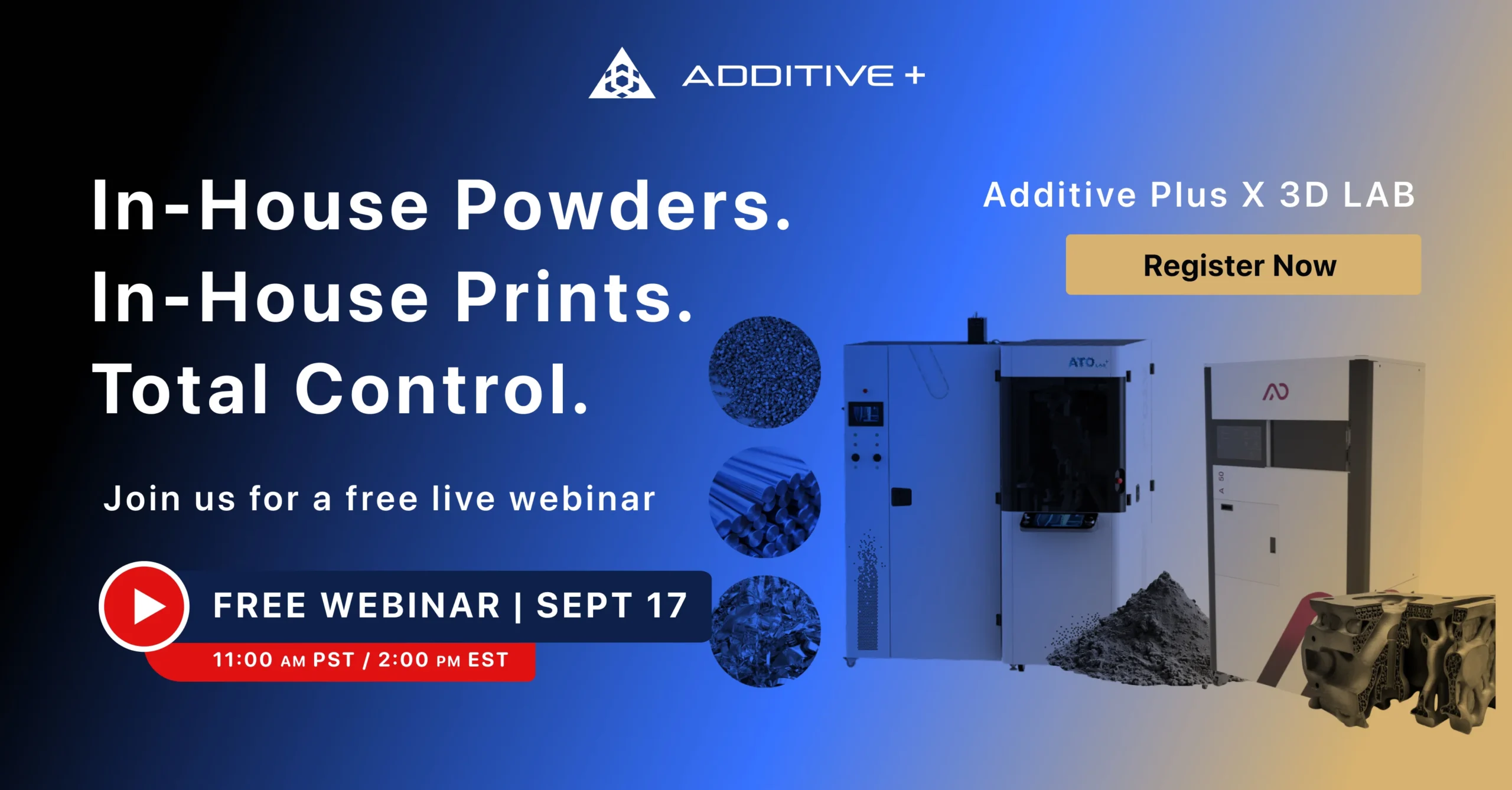
In-House Powders, In-House Prints: A Webinar by 3D LAB & Additive Plus
Metal 3D printing was supposed to make manufacturing faster and more flexible. Instead, it became expensive, oversized, and locked behind…