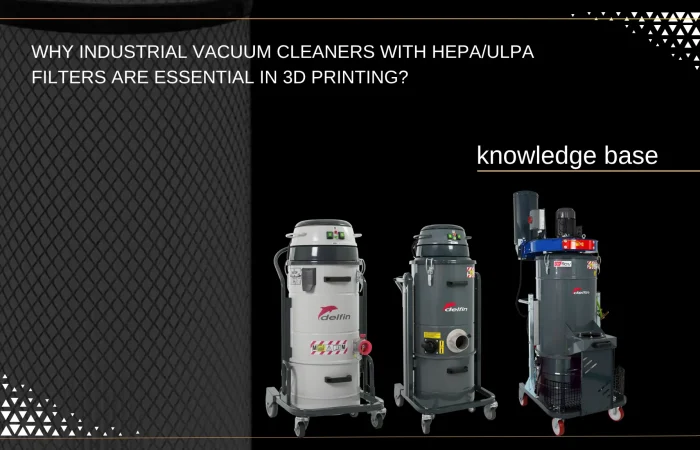
Why Industrial Vacuum Cleaners with HEPA/ULPA Filters Are Essential in 3D Printing
3D printing often leaves behind fine dust, powder, and airborne particles. These aren’t just messy; they can damage equipment, affect print quality, and put your team’s health at risk.
That’s why general-purpose vacuums aren’t enough. You need an industrial vacuum with a HEPA filter, or in some cases, a ULPA filter, to safely collect fine and hazardous particles at the source.
At Additive Plus, we support teams working with metal, resin, and polymer-based printing by offering vacuum systems designed specifically for additive manufacturing environments. Clean workspaces mean fewer failures, longer machine life, and safer conditions for everyone involved.
In this article, we’ll explain what HEPA and ULPA filters do, when to use each, and which vacuums are best for additive manufacturing. If you’re working with powders, resins, or sensitive parts, this guide is for you.
Looking for a solution now? Talk to our team or view our industrial vacuum lineup.
What Is A HEPA Filter And How Does It Work?
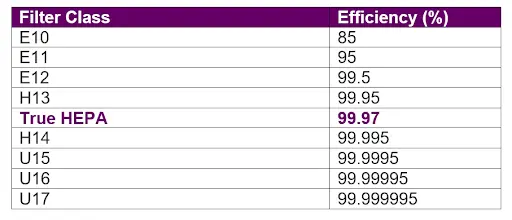
A HEPA filter (High-Efficiency Particulate Air) is a certified filter that removes 99.97% of particles that are 0.3 microns in size or larger. That includes common materials in 3D printing like metal powder, polymer dust, and resin particles.
Source: Wikipedia
But how does it actually work?
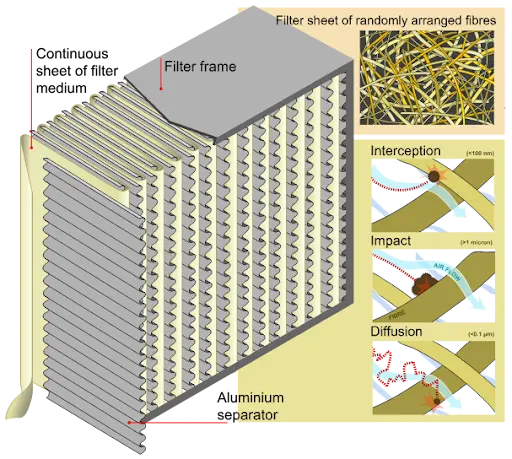
Unlike standard filters, HEPA filters use a dense, pleated fiber mesh to trap particles. As air passes through, contaminants are caught through three physical processes:
- Interception – particles stick to the fibers as they follow the airflow
- Impaction – larger particles can’t avoid the fibers and embed directly
- Diffusion – tiny particles (like fumes or nanoparticles) move randomly and get caught as they bounce around
This makes HEPA filters especially effective in capturing both large debris and fine, invisible particles that could otherwise harm your equipment or be inhaled.
Source: Winix
Many industrial vacuums also use pre-filters to trap larger debris first. This helps extend the life of the HEPA filter and reduce maintenance costs.
What Is A ULPA Filter And How Does It Work?
A ULPA filter (Ultra-Low Penetration Air) is a high-efficiency air filter that removes 99.999% of airborne particles down to 0.1 microns. That includes ultrafine dust, aerosols, bacteria, and other contaminants that standard or even HEPA filters may miss.
ULPA filters work the same way HEPA filters do, using a dense, pleated fiber structure. As air passes through the filter, particles are trapped by three physical processes:
- Interception – particles moving through the airflow brush up against and stick to fibers
- Impaction – larger particles can’t follow the air path and collide directly into the filter media
- Diffusion – very small particles move erratically (Brownian motion) and get caught in the fiber maze
Because ULPA filters are denser, they allow less airflow and create more resistance, which can lead to faster clogging and higher energy use.
That’s why they’re mainly used in cleanrooms, pharmaceutical labs, medical device manufacturing, and other settings where maximum particle control is critical.
What Is The Difference Between HEPA And ULPA Filters?
Both HEPA and ULPA filters are designed to trap very small particles from the air. The difference comes down to filtration efficiency, particle size, and how demanding your application is.
Here’s a quick comparison:
HEPA vs. ULPA Filters in 3D Printing
Category | HEPA Filter | ULPA Filter |
Filtration Efficiency | 99.97% @ 0.3 microns | 99.999% @ 0.1–0.3 microns |
Particle Size Captured | Fine dust, metal powders, polymer/resin debris | Ultrafine particles, biological and chemical contaminants |
Airflow Resistance | Lower – allows for better suction and airflow | Higher – requires more powerful fans, may reduce suction efficiency |
Filter Lifespan | Longer – less prone to clogging | Shorter – denser media clogs faster |
Operating Cost | Lower–affordable filters, lower energy use | Higher – costlier filters, increased power demand |
Use Case Examples | Standard AM labs, polymer/metal 3D printing, post-processing cleanup | ISO 3–5 cleanrooms, aerospace, pharma, medical AM applications |
Best For | General-purpose additive manufacturing | High-sensitivity environments with strict contamination control |
In most additive manufacturing environments, a HEPA filter is more than sufficient, especially for collecting resin dust, polymer powders, and excess metal. But if you’re working in a cleanroom (ISO Class 3–5) or handling high-risk biological materials, a ULPA filter may be required.
Still not sure which one fits your setup? Get in touch with us. We’ll help you decide based on your process and materials.
Why HEPA/ULPA Filtration Matters In Additive Manufacturing?
Additive manufacturing isn’t just about precision printing—it’s also about safe, controlled environments. Fine dust, leftover powder, and airborne particles are part of the process, but without proper filtration, they create serious risks.
Here’s where industrial vacuum cleaners with HEPA or ULPA filters come in. Let’s break it down:
1. Metal Powder Safety
Metal 3D printing (like LPBF) uses reactive powders such as titanium, aluminum, and stainless steel. These materials are:
- Toxic if inhaled
- Combustible under certain conditions
- Hard to contain with standard vacuums
A certified HEPA filter industrial vacuum helps capture fine metal powder during post-processing, powder changes, or cleaning around the build chamber. For highly sensitive setups, ULPA filters may be used with inert or explosion-proof vacuums.
2. Resin and Polymer Dust Control
SLA, FDM, and SLS processes often leave behind:
- Micron-scale plastic or resin dust
- Harmful fumes and fine particulates
- Build-up around optics or cooling fans
Using a vacuum with a HEPA filter ensures these particles are removed at the source, before they affect machine performance or operator health.
3. Protecting Sensitive Equipment
Dust isn’t just a health issue—it’s a mechanical one. Fine particles:
- Settle into optical systems, reducing print accuracy
- Accumulate in electronics, cooling systems, and motion rails
- Shorten the lifespan of precision equipment
HEPA/ULPA filtration keeps your machines in better shape, reducing maintenance costs and downtime.
4. Meeting Safety Standards
Many AM labs must comply with:
- OSHA and NFPA guidelines on combustible dust
- ISO Class cleanliness for specific industries (aerospace, medical, pharma)
ULPA filters help meet these stricter standards, especially in controlled cleanroom environments.
Proper filtration is part of responsible 3D printing, protecting both people and processes. Additive Plus offers industrial vacuum options built to handle all of the above.
Choosing The Right Industrial Vacuum With HEPA Filter For 3D Printing
Not every vacuum is built for additive manufacturing. You need one that can safely collect fine, potentially hazardous particles, without clogging quickly or damaging your workspace.
Here’s what to look for when selecting an industrial vacuum with a HEPA filter (or ULPA, when needed):
Key Features to Consider
✅ True HEPA or ULPA Certification: Look for filters that meet official standards—99.97% at 0.3 microns for HEPA, 99.999% at 0.1 microns for ULPA.
✅ Filter Staging: Pre-filters extend filter life by trapping large debris first. Multi-stage filtration is especially helpful in powder-rich environments.
✅ Inert or ATEX-Ready Construction: For combustible metals like aluminum or titanium, spark-free or inert vacuums are a must.
✅ Power and Airflow: Choose a model that offers enough suction power and airflow to keep up with your workspace demands.
✅ Tank Size and Portability: Larger tanks are better for production areas; compact models suit labs and workbenches.
Recommended Models From Additive Plus
Here are several options based on common 3D printing setups:
Model | Best For | Filter Type | Notes |
Small labs, portable use | HEPA | Dry-only, compact, lead/asbestos-safe | |
Contractors, job sites | HEPA | 20-gal tank, tool-activated | |
General AM cleanup | HEPA | High airflow (283 CFM), 3 bypass motors | |
Heavy-duty powder collection | HEPA (optional) | 8.4 HP, 353 CFM, 26-gal capacity | |
Integrated AM systems | HEPA (optional) | Maintenance-free, 221 CFM | |
Compact lab and electronics environments | HEPA (optional) | 412 CFM, compact, 11.9-gal tank | |
High-volume dust control | HEPA (optional) | 600+ CFM, larger tank, mobile design | |
Resin spills, wet/dry labs | Washable filter | Includes a pump for liquid discharge | |
Combustible powder zones | HEPA (optional) | Brushless motor, ATEX certified | |
Hazardous dust collection | HEPA (optional) | Compact and certified for Class II | |
Reactive powders (Al, Ti) | HEPA + Inert chamber | Stainless steel tank, safe disposal |
Need help choosing the right model for your 3D printing setup? Get in touch with us, we’re happy to help.
Clean Isn’t Optional, It’s Operational
Dust, powder, and particles are part of 3D printing. But if they’re not handled properly, they can quickly lead to equipment damage, failed prints, and health risks for your team.
That’s why using an industrial vacuum with a HEPA filter, and in some cases, a ULPA filter, is necessary for safe, reliable, and cost-effective additive manufacturing.
At Additive Plus, we work with research labs, production teams, and advanced manufacturing facilities that print every day with polymers, metals, resins, and ceramics.
We’ve helped them choose filtration systems that match their materials, environments, and compliance needs.
If you’re printing with powders or working in a sensitive environment, don’t wait until a problem shows up. Take a proactive step to protect your workflow.
👉 Explore our industrial vacuum systems built for additive manufacturing
👉 Talk to our team about your setup, and we’ll help you find the right fit.
FAQ
Can I retrofit an existing vacuum with a HEPA filter for use in 3D printing?
Retrofitting a general-purpose vacuum to include a HEPA filter isn’t recommended for additive manufacturing environments. A proper HEPA filter industrial vacuum is engineered with sealed components, multi-stage filtration, and a motor system that can handle fine powders without leaks or bypass. In 3D printing, particularly when working with reactive or toxic materials, containment and safety can’t be left to guesswork. Investing in an industrial vacuum that’s built from the ground up to support HEPA-level filtration ensures reliable performance, regulatory compliance, and operator protection.
Do I need a different industrial vacuum with HEPA filter for metal vs. polymer printing?
Yes, in many cases. If you’re working with metals—especially reactive or combustible powders like aluminum, titanium, or magnesium—you’ll need a HEPA filter industrial vacuum that’s antistatic or inert-capable, possibly even ATEX-rated depending on your local regulations. For polymer-based printing, such as FDM, SLA, or SLS, you can use a general-purpose industrial vacuum with HEPA filter, provided it’s rated for fine particulate collection. The key is choosing a system that’s matched to both the particle type and the environment you’re operating in.
What are the risks of using a non-HEPA vacuum in a 3D printing setup?
Using a standard vacuum without HEPA filtration may not seem like a big issue at first—but over time, it can create real problems. Fine powder particles can be re-released into the air during cleaning, exposing operators to respiratory hazards and contaminating sensitive components. This is especially problematic in metal 3D printing, where even trace contamination can impact build quality or lead to safety violations. A properly sealed industrial vacuum with HEPA filter contains and captures these particles at the source, preventing buildup, minimizing airborne exposure, and supporting clean workspaces that meet both safety and performance standards.
How can I tell when a HEPA filter needs to be replaced?
If you’re using a professional-grade HEPA filter industrial vacuum, there are usually signs when the filter is nearing the end of its life. Reduced suction power or increased motor strain often indicate that airflow is being restricted by a clogged filter. Some units have integrated pressure drop indicators or warning systems. If your system doesn’t include those, a scheduled maintenance plan based on hours of use, material type, and environment is your best approach. For high-volume powder use, many customers replace HEPA filters every 6–12 months, while regularly changing pre-filters to extend filter life.
Is it better to have one vacuum for all machines or separate vacuums per material type?
If your facility runs multiple 3D printers with different materials—say, polymers on one machine and metal powders on another—it’s smart to use dedicated vacuums per material type. This reduces the risk of cross-contamination, simplifies maintenance, and helps with traceability in quality-sensitive workflows.
For example, many research labs and regulated production facilities use a separate industrial vacuum with HEPA filter for each machine group or room, ensuring proper containment and clearer recordkeeping. It may cost more upfront, but it pays off in cleaner results and fewer downstream issues.
Related Posts
3D printing often leaves behind fine dust, powder, and airborne particles. These aren’t just messy;…