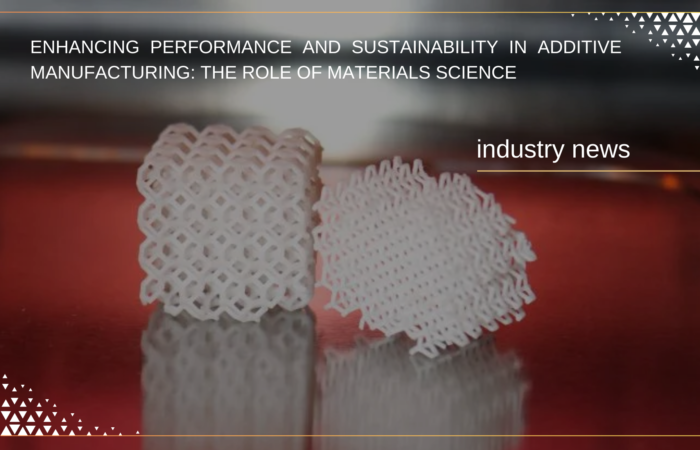
Enhancing Performance and Sustainability in Additive Manufacturing: The Role of Materials Science
The information presented in this article is inspired by insights from 3DN Magazine, which explores innovative approaches to additive manufacturing and emphasizes the importance of materials science in overcoming challenges in metal and ceramic additive manufacturing. The magazine highlights the convergence of advanced materials and cutting-edge manufacturing techniques, showcasing their potential for improving performance and sustainability across various industries.
Materials are, and always will be, the core of additive manufacturing. But being able to pick the right one for the right application, and making it with the right process, is a constant challenge for many looking to adopt the technology. And this is doubly the case when it comes to ceramic and metal AM. This is where companies like Lucideon come in. With robust R&D departments and extensive experience in material development as well as the technologies, they are at the forefront of increasing the usability of AM for different applications in a variety of sectors. 3DN sat down with two Lucideon experts, one specializing in metals and the other in ceramics, to learn more.
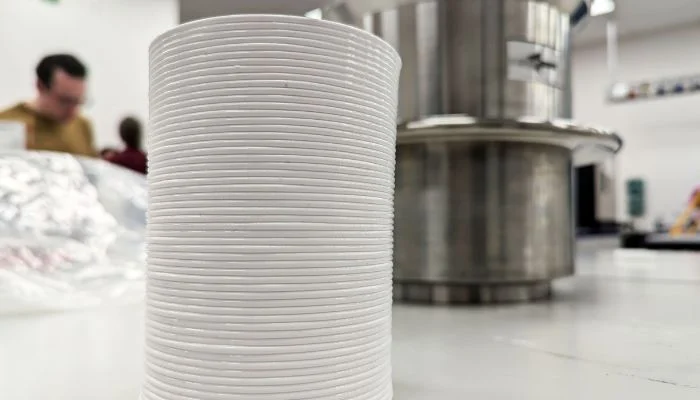
In an interview with 3DN Magazine, Robert Crookes, head of advanced materials at Lucideon, introduces the company as a materials development and validation firm based in the UK. Lucideon specializes in engineering ceramics and additive manufacturing processes for industries such as aerospace, defense, and nuclear power. The company has roots in the British Ceramics Research Association and has evolved through various rebranding efforts since the 1970s.
Julius Bonini, a metallurgist and principal consultant at Lucideon, highlights the company’s extensive experience in additive manufacturing, particularly with metals, and its collaboration with aerospace OEMs for failure analyses. The US branch, known as Lucideon MP, focuses on testing and consulting across various sectors, including advanced ceramics, metallurgy, and pharmaceuticals, with a particular emphasis on stress corrosion cracking testing and hybrid manufacturing techniques.
What are the challenges in developing materials for AM?
RC: There are a handful of major challenges, and one of the biggest is achieving the correct material densities. In ceramics, you want them to be fully dense to really unlock their extraordinary thermal and mechanical properties, but a lot of AM techniques struggle with that. Some of the mature technologies involving DLP and SLA are good at achieving thin walls, but they are extremely costly, especially when you consider that the cost does not just factor in the printer and materials, but also the necessary post-processing. This makes cost-effectiveness a challenge.
With other technologies, they are almost the mirror opposite: the process is cost effective and you can achieve density, but the tradeoff is the currently possible degree of printing resolution. Although, I will say that ceramics are much more of an emerging material family compared to metal AM, with very few solutions that are fully available, meaning that there is still a bit of a race ongoing.
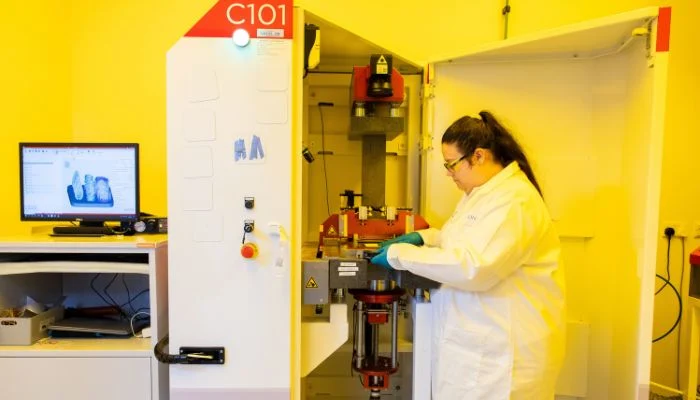
Ceramic SLA at Lucideon – 3DCeram C101 Easy Lab
JB: What is interesting is that on the metal side of AM, we have gotten over our major challenges already. A few years ago, we were still dealing with the challenge of achieving fully dense parts, but now across the industry people are getting 99% density or better. That has become common over most of the materials: stainless steels, titanium, etc. The challenge now is in getting new materials and especially the powder in the right way. How do we expand beyond our current alloys and get them prepared for medical and aerospace applications?
Much like Robert was talking about, our biggest challenge is cost- and time-reduction. For example, we have worked on adjusting laser parameters which can result in significant time savings. But when people are trying to cut corners to make it faster, that is when the failures happen. Our job is to see how to adjust that, how to make these tweaks more effective without diminishing the quality of the final part.
The third challenge centers on material design allowables. What do I mean by this? Well, there may be a case where people will want specific properties in AM for different things and that has become the new design standard for the industry.
Could you talk to us specifically about materials for ceramic and metal AM? What are their specific needs and differences?
RC: With ceramics, we need to be realistic about challenges based on the materials’ brittleness and flaw sensitivity. They create nice, complex shapes, but users need to be careful in how they implement AM due to the possibility of catastrophic failure with sharp edges.
There are some solid and niche applications, like in the medical field which is looking heavily at ceramic AM for implants. We see a lot of clients exploring AM for complex lattice work and light weighting abilities for things like alumina and zirconia. In the end, what we really need is to reliably produce these things without fail. This is why research and expertise on the materials and processes is still so important.
To name some areas where ceramic AM has potential applications, the big ones are defense, aerospace, and nuclear power, even if current work is more exploratory. Some of the industries where ceramic AM is more consistently used are automotive and medical, but Lucideon is not directly handling those. Right now, we are really feeling the way forward with where ceramic AM lies in the industry.
JB: On the metal side, there are a lot of differences. To illustrate, we can look at aerospace vs. medical, for example. With wire-arc additive manufacturing, aerospace is building the rocket, and with powder they are making engines. They build a lot of big parts that take a lot of time. Again, they run into that design allowable issue because they have fatigue concerns. How do we get design allowable for fatigue resistance for the large components that they are making for space applications?
At the same time, medical wants a lot of small things fast. You can only use titanium and cobalt chrome, but what is important is cost and time. This is where development is important as many in the sector are going back to conventional manufacturing as they see costs going up too much and they can make it quicker that way.
Could you speak more on the importance of certification? Where is the market right now? How can you help?
RC: It is interesting on the ceramics side because this is something that has been talked a lot about in metal AM, but it is not discussed at all in ceramics. We are not at that point yet, but it is going to be a massive challenge. Even the question of validation is not clear: do you validate each part for each form? That is the big debate in metals right now. If we must do the same in the ceramics route, it will be to an even greater extent, and I would not be surprised if you had to fully NDT (non-destructive test) every part to look for defects. This is one of the areas where we are working to advance the field.
Another is improving material performance. Will a given material sinter to a higher density? Will it flow with the right properties? Then there are considerations for post-processing, which is massive for ceramics, where the printing is less of a complete manufacturing process: post-print, nearly all current processes require debinding and sintering which can introduce challenges to the component. That is another aspect of Lucideon’s offering, with all the post-processing of the component.
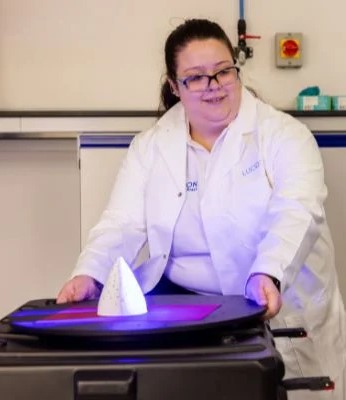
Analyzing a ceramic AM part.
JB: It is complicated on the metal side. We have three certifying agencies in the USA: the FAA, FDA and NASA. NASA is for above the atmosphere; the FAA is for atmosphere to ground; and FDA is for all the people on ground. They have very rigorous certification processes to go through and for AM it has always been a challenge. However, now that we are a little more mature, it is much easier now to get a new component certified because we have all that data from previous cases, even if it is still a challenge.
Why? Well, if we make a change to one thing, it is necessary to go back to the certifying agency. We used to NDT it and just sacrifice a part; now we can often use test data from coupons and historical data instead. But now people are implementing machine learning and AI to predict product performance based on build information. It is becoming the new thing that people want to observe because it will save them long-term costs and time and they are trying for this validation. I am not an expert, but it looks interesting and will probably help develop the field even further.
Explore What’s New in 3D Printing
Unleash Creativity This Holiday Season with EinStar Vega & EinStar 3D Scanners
How to Line Up 3D Printed Parts: Techniques for Perfect Assembly
How to Clean a 3D Printer Nozzle: Easy Steps for Optimal Performance
Can You 3D Print Metal? A Comprehensive Guide to Metal 3D Printing Technologies
3D Printing for the Medical Industry: A Review of Essential Technologies and Trends
Related Posts