Skip to content
News_Additive-Plus_Updated

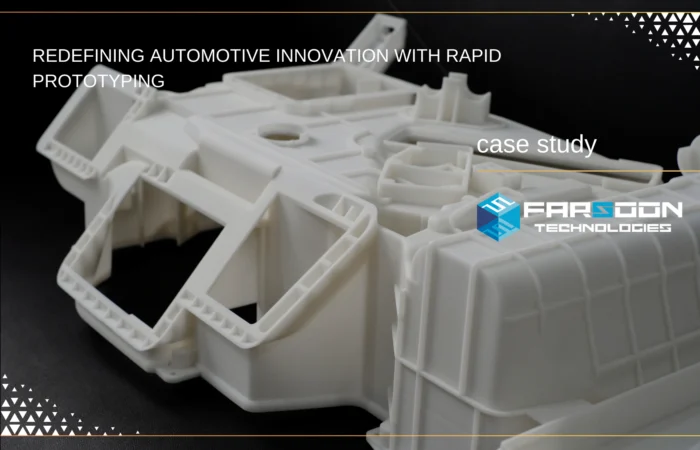
Redefining Automotive Innovation with Rapid Prototyping

Automotive development is moving fast. Tight deadlines, rising material costs, and complex part requirements make traditional manufacturing harder to justify early in the process. That’s why more teams are turning to rapid prototyping.

But what is rapid prototyping, and why does it matter to automotive manufacturing?

In simple terms, it’s a faster, more flexible way to test part designs using tools like 3D printing. With rapid prototyping automotive teams can produce parts in hours instead of weeks—cutting costs, speeding up testing, and reducing risk. Whether it’s early R&D or late-stage design validation, rapid prototyping helps solve problems before they become expensive mistakes.

At Additive Plus, we work closely with manufacturers to bring proven solutions like 3D printing automotive parts to life. 

This case study highlights how Farsoon Technologies—one of our technology partners—is helping automotive suppliers simplify development and stay competitive through 3D printing in automotive industry applications.

Traditional Manufacturing Limitations In Automotive Prototyping

Before adopting rapid prototyping, most automotive teams rely on methods like CNC machining or silicone molding for early part production. While these techniques are familiar, they come with major drawbacks—especially when time and precision matter.


Common Limitations of Traditional Methods:


  • CNC Machining: Creating large, detailed parts using CNC often means breaking them into smaller pieces, machining them one by one, and then assembling them by hand. This introduces delays, labor costs, and potential for errors at the joining points. Plus, tight design features like undercuts are often hard to achieve without multiple tool changes.
  • Silicone Molding: This method requires a long, multi-step process to create just one mold. It’s slow, costly, and lacks the accuracy needed for high-tolerance parts. Shrinkage, warping, and dimensional variation are common issues, especially problematic in automotive use cases where every millimeter counts.
  • Limited Design Flexibility: Both methods restrict the complexity of part designs. Parts with organic shapes, internal structures, or curved cavities may need to be redesigned just to fit manufacturing constraints.

These limitations slow development and increase production risk when working with automotive components like HVAC housings, intake systems, or dashboard assemblies. Rapid prototyping automotive solutions, especially 3D printing in automotive industry workflows, offer a better path forward.

With 3D printing automotive parts, you can skip tool changes, simplify your process, and build the exact geometry you need from day one, cutting days or even weeks off your timeline.

Farsoon’s Breakthrough With The HT1001P: Automotive HVAC Housing Case Study

One clear example of rapid prototyping automotive success comes from Farsoon Technologies, in collaboration with SAPW Automotive Technology Co.

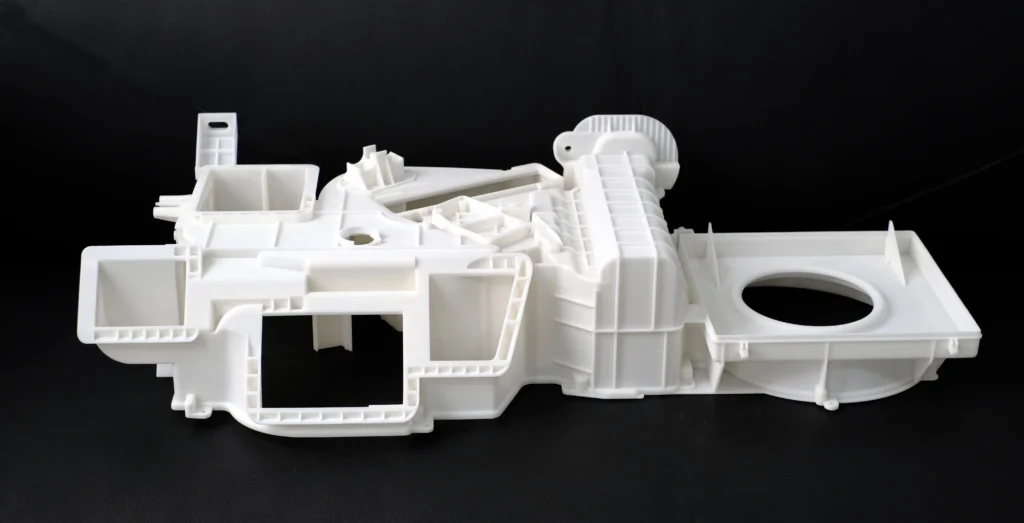
The challenge? Producing a large, highly detailed HVAC (Heating, Ventilation, and Air Conditioning) housing, normally assembled from multiple CNC-machined or molded parts, into a single, functional prototype.

The Traditional Process:

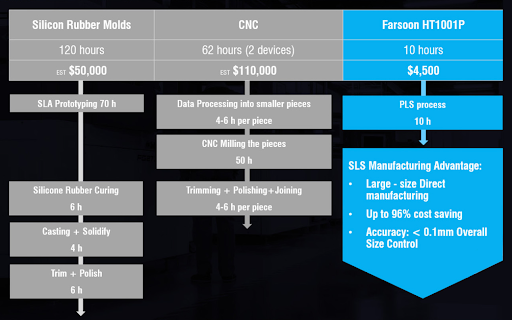
  • CNC Manufacturing: Required segmenting the design, 50+ hours of machining, and additional time for manual assembly.
  • Silicone Molding: Took over 120 hours from start to finish, with accuracy limitations and a labor-intensive process.

Both methods introduced complexity, high labor costs, and potential fitment issues. They weren’t efficient or reliable enough for an application that needed smooth surfaces, tight tolerances, and internal structures.

unnamed-10

What Changed with 3D Printing?

Using the Farsoon HT1001P, the same HVAC housing was printed as one seamless part in just 10 hours.

  • No cutting or re-assembly required
  • No added tooling or custom fixturing
  • Stronger part quality with no joint weaknesses
  • Smoother internal channels for airflow
  • Lower material and labor costs

This is a real-world application of 3D printing automotive parts—delivering speed, strength, and functional design in a way that traditional methods couldn’t match.

About the HT1001P:

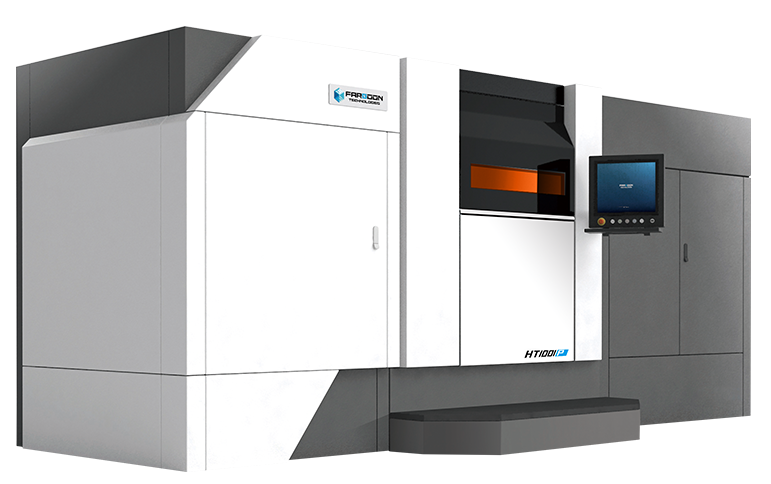
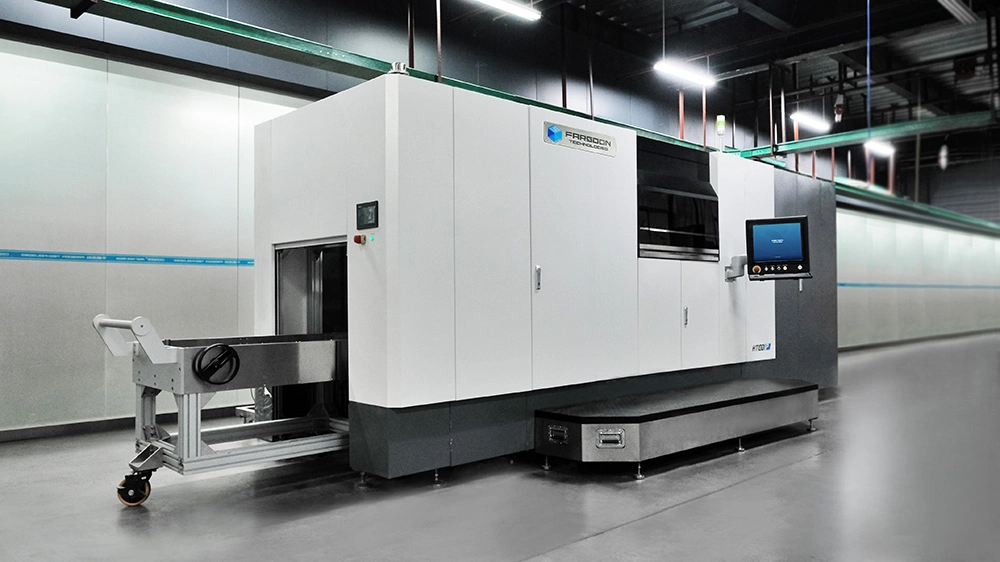
Farsoon’s HT1001P is designed for industrial-scale prototyping and low-volume production. With a build size of 1000 x 500 x 450 mm, it’s built to handle large-format polymer parts with complex internal features—ideal for the automotive sector.

Farsoon_HT1001P-pic_Clean_light

Buy the Farsoon HT1001P-2 SLS 3D Printer for High-Precision Polymer Manufacturing with financing today!


The machine supports engineering-grade materials like PA6 and PA12, offering heat resistance and durability suitable for functional use.

This case answers the question of “What is rapid prototyping?” and shows exactly how it applies cost-effectively and technically soundly to modern automotive manufacturing.

Why 3D Printing Excels In Automotive?

The HVAC housing case is just one example of how 3D printing automotive solutions outperform traditional manufacturing. Across the industry, engineers are adopting rapid prototyping because it removes long-standing bottlenecks in speed, cost, and complexity.

1. Complex Geometries Made Simple

Whether it’s detailed airflow channels, undercuts, or internal brackets, 3D printing builds them in a single process—no segmentation, no specialized tooling. Engineers can focus on performance rather than adapting designs to fit manufacturing constraints.

2. Faster Turnaround

With rapid prototyping automotive solutions like Farsoon’s HT1001P, lead times drop dramatically. Parts that once took 60 to 100 hours to produce through machining or molding can now be printed in under 10 hours. This speed is essential for quick design iterations and faster development cycles.

Automotive_HVAC_FS3300PA_HT1001P-scaled

 3. Lower Development Costs

3D printing cuts out the need for expensive tooling and reduces manual labor. You can consolidate multiple components into one printed part, minimizing assembly time and lowering the overall cost of prototyping and testing.

4. Functional Materials for Real-World Use

Today’s materials are built for durability. From high-performance nylon to heat-resistant composites, 3D printing automotive parts now meet structural, thermal, and functional demands, making them suitable for hands-on testing and even limited production.

unnamed-11

Source: Precedence Research 

If you’re asking, “What is rapid prototyping?” in today’s automotive world, it’s a smarter, faster way to design and build parts without the delays and constraints of traditional methods.

 5. Made for Customization

Each prototype can be quickly adjusted, reprinted, and tested—without retooling. This makes rapid prototyping ideal for low-volume production, variant parts, and validation samples.

6. A Fast-Growing Market

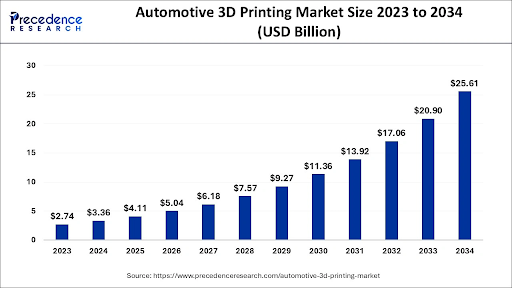
This isn’t a niche solution. It’s the direction the industry is heading. The global 3D printing in the automotive industry was valued at $3.36 billion in 2024 and is expected to exceed $25 billion by 2034. That’s a yearly growth rate of over 22%, with North America accounting for more than $1.3 billion of that share.

Race-Proven Innovation – The FNX-17 Case

Rapid prototyping for automotive isn’t just for design studios or labs. It’s actively used in high-performance environments, like university-level formula race car competitions. Farsoon Technologies, a key partner of Additive Plus, has supported student teams in China with advanced 3D printing automotive solutions for years.


A Real-World Example: The FNX-17 Race Car


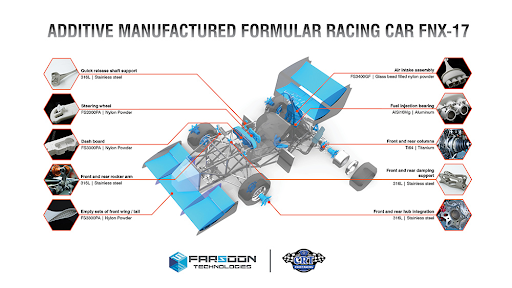
The FNX-17, developed by Changsha University of Technology, showcases what’s possible when 3D printing automotive parts becomes part of the design and manufacturing process. More than 30 key components of the car—such as the steering system, air intake, and rocker arms—were created using Farsoon’s industrial 3D printers.

unnamed-_12_

Key Benefits Demonstrated:


  • Lightweight Components: Critical parts like the front and rear hubs were produced using titanium and stainless steel. One redesigned front column achieved a 44% weight reduction compared to CNC machining.
  • Shorter Development Time: Traditional parts can take 6–8 months to machine, adjust, and test. With rapid prototyping, most of the race car’s components were designed, printed, and tested in weeks, not months.
  • Performance Gains: The final car weighed just 250 kg and reached 100 km/h speeds. The printed parts’ strength, precision, and material quality met the intense mechanical demands of competitive racing.

Why It Matters?


This is a strong case for 3D printing in automotive industry applications. Race teams operate under tight timelines and demand high performance. Farsoon’s success with the FNX-17 shows that rapid prototyping isn’t just about iteration—it can directly support final-use parts under real stress.

Additive Plus And Farsoon – Building The Future Together

At Additive Plus, we bring industrial-grade 3D printing technology to manufacturers who need reliable, real-world solutions. Our partnership with Farsoon Technologies gives automotive teams access to the same high-performance platforms used in real-world applications like HVAC prototyping and formula racing.

We don’t just sell equipment—we help you apply it effectively.

Whether you’re exploring what rapid prototyping is, or already working with 3D printing in automotive industry settings, our team provides:

  • Consulting: Guidance on the right printer, material, and workflow for your application.
  • Technology Access: Large-format systems like the HT1001P are designed to meet demanding part size and quality standards.
  • Support & Training: We help your team learn and apply the tools, ensuring production stays on track.

You’ll find our full line of industrial 3D printers here, including advanced SLS and metal AM systems.

If you’re working with 3D printing automotive parts, Additive Plus gives you the infrastructure, materials, and support you need to go from design to part, without delay.


📩 Contact us today to explore how we can help your team move faster, test better, and build smarter with 3D printing.

Rapid Prototyping That Works In The Real World

Rapid prototyping automotive projects are no longer limited to conceptual models. With technologies like Farsoon’s HT1001P and the support of Additive Plus, automotive teams are using 3D printing to produce functional parts faster and more efficiently.

From single-piece HVAC systems to lightweight racing components, 3D printing in automotive industry settings delivers practical benefits: fewer assembly steps, better design freedom, shorter development cycles, and real performance improvements. Whether you’re just learning what rapid prototyping is, or you’re looking to upgrade your production process, the opportunity is clear.

Additive Plus connects you with the machines, materials, and knowledge to make it happen.

Ready to improve your prototyping and production workflows? 

Explore our 3D printer lineup today.

Request a quote

Scan My Object

Please describe your part and scanning needs. Include details like size, material, and how you plan to use the 3D model. Let us know if you require additional services like digital sculpting. Upload images of your part(s) if you have them.

Ask for details

Partner with us

Get instant quote

Talk to Material Expert

Select the unit of measurement for your file
No 3D file? We’ve got you. We can design it for you or scan your existing part.
Upload a photo or drawing if you have one — we’ll get in touch soon.
Select the unit of measurement for your file
No 3D file? We’ve got you. We can design it for you or scan your existing part.
Upload a photo or drawing if you have one — we’ll get in touch soon.
Select the unit of measurement for your file
No 3D file? We’ve got you. We can design it for you or scan your existing part.
Upload a photo or drawing if you have one — we’ll get in touch soon.
Select the unit of measurement for your file
No 3D file? We’ve got you. We can design it for you or scan your existing part.
Upload a photo or drawing if you have one — we’ll get in touch soon.