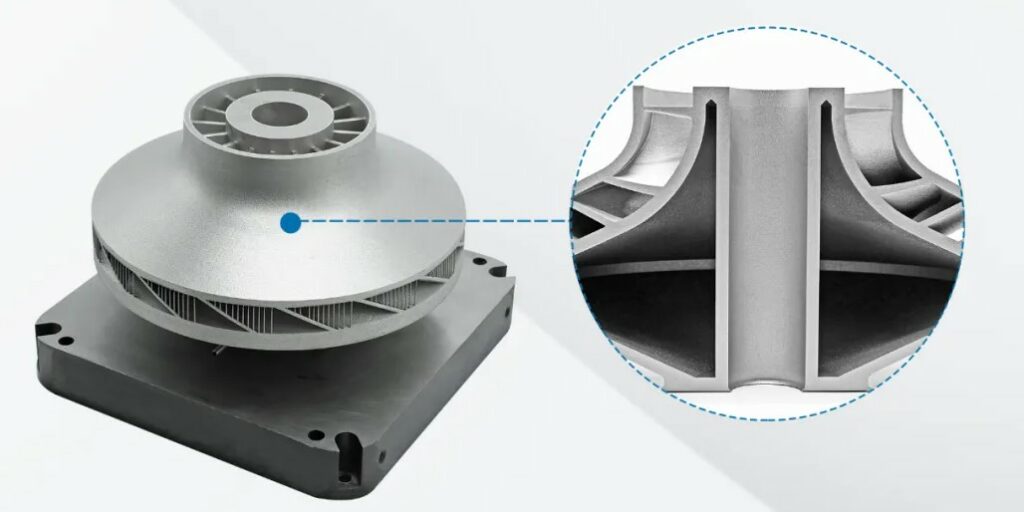
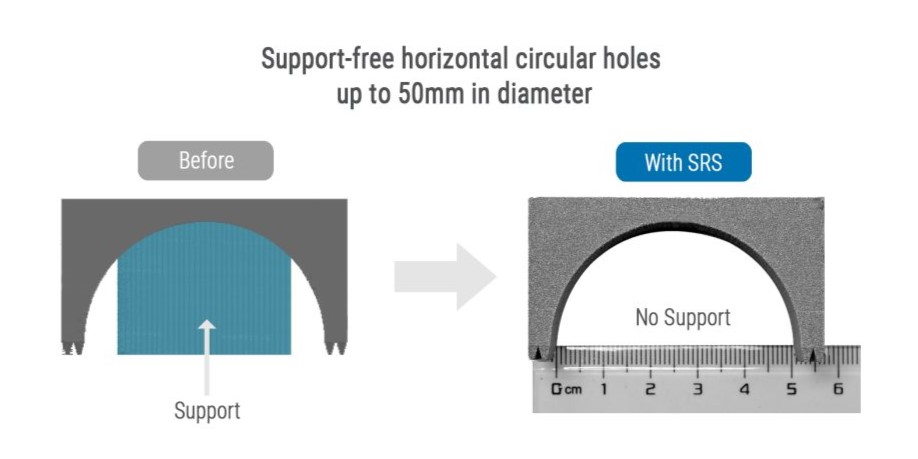
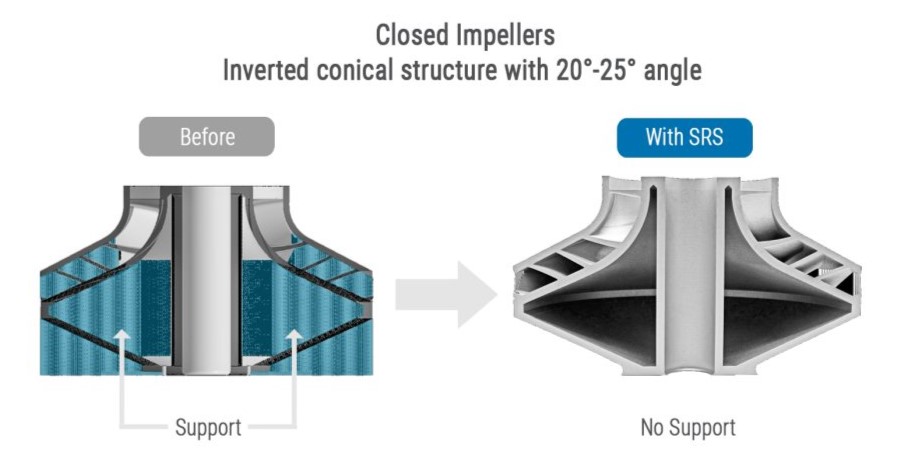
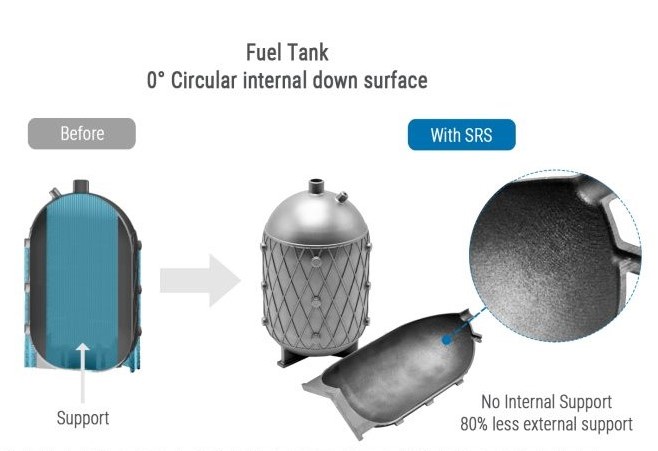
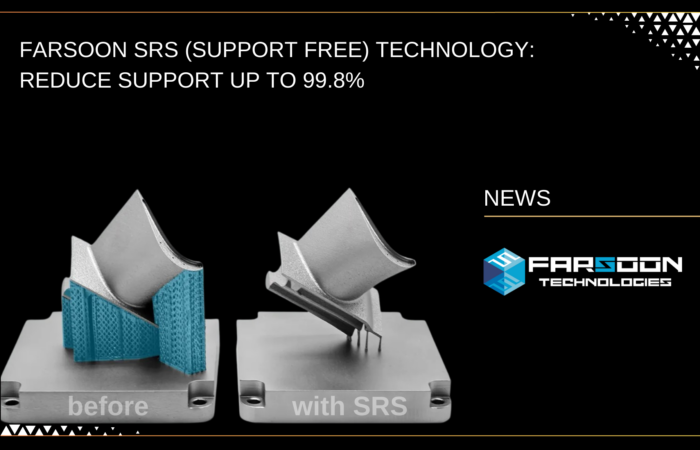
Farsoon Technology has successfully achieved support-free technology for special structures such as horizontal circular holes and inverted cones.
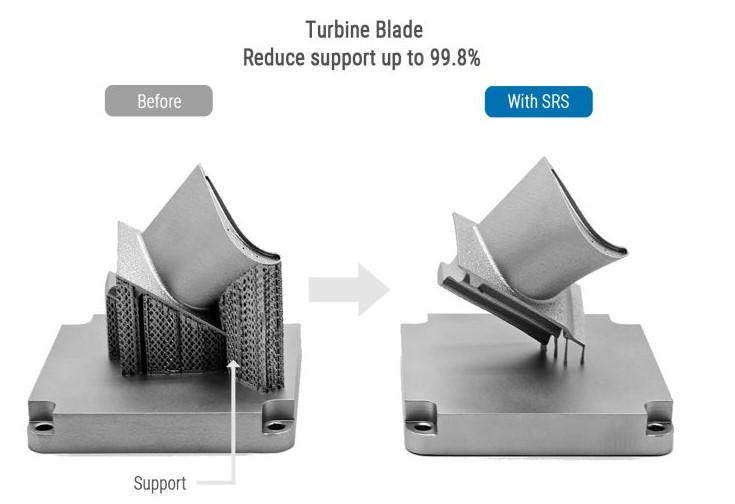
Farsoon SRS (Support Free) Technology: reduce support up to 99.8%
Support-free technology allows the production of complex geometries without the need for additional support structures. This innovation is particularly beneficial for creating intricate designs, such as horizontal circular holes and inverted cones, which are often challenging to manufacture using traditional methods.
Support-free technology not only reduces material waste but also minimizes post-processing time and costs associated with removing supports. This capability enhances design freedom, enabling engineers and designers to explore more innovative solutions and optimize parts for performance and weight reduction.
Advances in Suspended Structures and Support-Free Printing
The smooth formation of parts is a fundamental requirement in additive manufacturing. However, the rapid cooling rates associated with metal powder bed fusion technology can create significant internal stresses during the forming process, leading to deformation of the parts. This issue is particularly pronounced in suspended structures, where warping can result in printing failures—an ongoing challenge for designers.
Thanks to relentless innovation and independent research and development, Farsoon Hi-Tech, a leader in industrial 3D printing, has tackled these technical hurdles head-on. They’ve successfully mastered the creation of complex structures like inverted cones and horizontal circular holes. Notably, they can achieve an infinite height for inverted cone structures with angles between 20° and 25°. Additionally, they can form horizontal circular holes up to 50mm in diameter without the need for support.
Metal additive manufacturing faces support design challenges
A well-thought-out structural design and the right forming process are crucial for achieving smooth part production. In metal additive manufacturing, creating suspended structures often requires additional support, particularly in areas with a low-hanging angle. Typically, support structures are added to any suspended sections that have an inclination of less than 45 degrees to minimize the risk of failure during the printing process.
However, using supports comes with its own set of challenges. For starters, adding supports means consuming extra powder material, which not only prolongs printing time but also complicates post-processing efforts. Some supports can be difficult or even impossible to remove without damaging the final part, rendering it unusable.
To tackle these issues, designers must carefully consider the unique characteristics of additive manufacturing and make structural adjustments to reduce the need for supports while ensuring they remain removable. This can impose additional constraints on the design process.
Given these challenges, it’s essential to refine the forming process and improve the capability of materials and techniques for low-angle formations. Enhancing these aspects can significantly streamline production and lead to better outcomes in metal additive manufacturing.
Special structure to achieve no support
Farsoon understands that the forming capability in additive manufacturing is heavily influenced by factors like material choice, layer thickness, and process parameters. Interestingly, even structural parts with the same inclination angle can present varying degrees of forming difficulty. For instance, creating an inverted cone is generally more challenging than forming a right hollow cone, despite their identical angles.
This highlights the importance for material and process developers to establish clear verification standards for forming capabilities. Farsoon has dedicated significant resources to forward-thinking research and development aimed at optimizing material forming processes. With years of technical expertise and innovative breakthroughs under their belt, they’ve developed proprietary slicing software that employs adaptive intelligent scanning strategies. This allows for precise control over energy input and localized heating during production. As a result, Farsoon has significantly enhanced forming capabilities while maintaining part density, outperforming traditional scanning technologies.


At Farsoon High-Tech, the team is committed to continuous innovation and independent research and development. They have successfully addressed the technical challenges associated with forming complex structures, such as inverted cones and horizontal circular holes. Their latest breakthrough enables the infinite height forming of inverted cone structures with inclination angles ranging from 20° to 25°. Additionally, they can create horizontal circular holes up to 50mm in diameter without the need for support.
Farsoon’s process optimization not only reduces the number of supports required for these intricate parts but also enhances design flexibility. This advancement allows clients to push the boundaries of their workpiece designs while simplifying post-processing requirements. With Farsoon, customers are not just accessing advanced technology; they are gaining the freedom to innovate.
More than 10 applications have been mass-produced


The low-support technology has been applied to dozens of workpieces and achieved mass production. The materials include titanium alloy, high-temperature alloy, aluminum alloy, stainless steel, etc. Typical applications include fuel tanks, closed impellers, valve bodies, nozzles and other parts, and the maximum size of the workpiece exceeds 450mm.
Three major advantages of low support/no support technology
Cut production and post-processing time while slashing costs. For instance, when producing an IN718 closed impeller with a diameter of about 130mm and a height of around 50mm, you can reduce printing time by 33% and lower costs by over 25%. Parts that require more supports can see even greater savings in both time and expenses.
Enhance your product quality by minimizing metallurgical defects that often arise at the junction where supports meet the workpiece. When you remove those supports, the workpiece itself can be vulnerable to damage. Plus, any debris left behind can easily infiltrate narrow structures like flow channels, leading to unwanted material buildup. By cutting down on the amount of support needed, you can significantly mitigate these issues and boost the overall integrity of your parts.
Unlock new design possibilities! Say goodbye to the old 45° forming angle constraint and expand your creative horizons. Take small parts with intricate inner cavity structures, for instance. Traditional printing methods often force you to tweak your designs or pile on excessive support, which can lead to local deformations in those delicate areas. By embracing a support-free strategy, you can achieve smooth, flawless formations without compromising your design integrity. Let your creativity flow!
Metal additive manufacturing technology still has great potential to be tapped
Farsoon will continue to conduct in-depth research and exploration of the potential of metal additive manufacturing technology and innovative processes to further unleash its innovative vitality and development space.