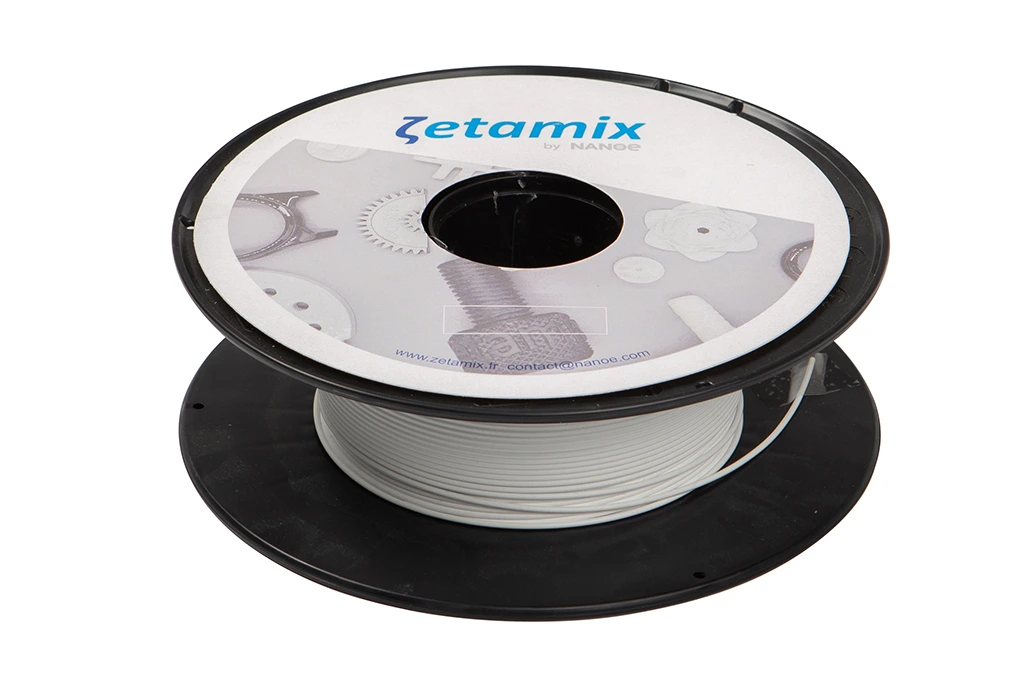
Zetamix TiO2 Filament 1,75mm
$535
TiO2 ceramic filament: Print FDM RF components → sinter into high-permittivity (ε=75) parts for microwave & antenna applications.
-
Compatible platform:
FFF
-
Type:
Metal Filaments
-
Categories:
Materials, Composite Tooling, Engineering, FFF(FDM), Filaments, Jigs&Fixtures, Manufacturing, Metal Filament
- Description
- Details
- Materials
- Documents
- Videos
- Review
Description
Zetamix TiO2 Filament enables direct manufacturing of specialized ceramic components with exceptional dielectric properties using standard FDM 3D printers. Create complex RF/microwave devices, antennas, and waveguides with permittivity values unmatched by conventional materials—opening new possibilities in high-frequency electronics and telecommunications.
Why RF Engineers & Researchers Choose Zetamix TiO2
Exceptional Dielectric Performance
Very high permittivity: ε = 75 (±5) at 9.4 GHz
Low loss tangent: 1×10⁻³ to 5×10⁻³
Stable performance from -50°C to +110°C (±5%)
Ideal for miniaturizing RF components and antennas
Advanced Ceramic Properties
98-99% theoretical density after sintering
Titanium dioxide (rutile) composition – 81% by mass
Excellent thermal and chemical stability
White ceramic appearance after sintering
Precision Manufacturing Workflow
- Predictable shrinkage: 18.97% (X/Y) & 20.44% (Z)
- Optimized for complex geometries impossible with traditional ceramics
- Batch-consistent dielectric properties
- Compatible with most FDM/FFF systems
Dielectric & Material Properties
Dielectric Constant: 75 ±5 (@ 9.4 GHz)
Loss Tangent: 0.001 – 0.005
Sintered Density: 98-99% of theoretical
Specific Gravity: 2.59 g/cm³ (filament)
Your Path to Advanced RF Components
1. Design for RF Performance
Scale models by 123.4% (X/Y) and 125.7% (Z) for sintering shrinkage
Minimum 2 wall layers with 5-100% infill density
Optimize for high-frequency performance requirements
Consider anisotropic effects on dielectric properties
2. Precision Printing Protocol
Use grooved drive gears to prevent filament grinding
Print on flexible build plates for easy removal
No cooling fan required during printing
0.5mm retraction at 80 mm/s recommended
3. Controlled Debinding & Sintering
Chemical Debinding: 6h acetone bath at 40°C (>7% mass loss)
Thermal Debinding: 8°C/h ramp to 500°C (≈2.5 days)
Sintering: 30°C/h to 1300°C with 2h hold in air atmosphere
FAQs
What makes TiO2 particularly valuable for RF applications?
TiO2 (rutile) offers an exceptionally high dielectric constant (ε=75) with low loss, enabling miniaturization of RF components while maintaining performance—ideal for antennas, filters, and waveguides.
How stable are the dielectric properties with temperature?
Excellent stability—the dielectric constant varies only ±5% across a wide temperature range from -50°C to +110°C, making it suitable for demanding environmental conditions.
What RF applications is this material best suited for?
Microwave antennas, waveguide components, RF filters, dielectric resonators, phase array systems, and any application requiring high permittivity with low loss at microwave frequencies.
How does the sintering process affect dielectric properties?
Proper sintering to 1300°C achieves 98-99% density, which is crucial for consistent dielectric performance. Lower densities may reduce the permittivity value.
What design limitations should I consider?
Standard ceramic design rules apply—avoid sharp corners, maintain uniform wall thicknesses where possible, and account for anisotropic shrinkage (different in X/Y vs Z).
Can I create complex geometries with internal features?
Yes! This is a key advantage over traditional ceramic manufacturing. Create intricate waveguide structures, complex antenna shapes, and internal channels impossible with conventional methods.
How long does the complete process take?
Printing varies by model. Chemical debinding takes 6h + 2h drying, thermal debinding ≈60h, and sintering ≈43h including ramp times and holding.
What safety precautions are necessary?
Standard ceramic filament handling—use in well-ventilated areas during printing and debinding. The sintered TiO2 is biologically inert and safe for handling.
What's the shelf life of the filament?
Six months when stored in original vacuum-sealed packaging in cool, dry conditions
Can I achieve different permittivity values?
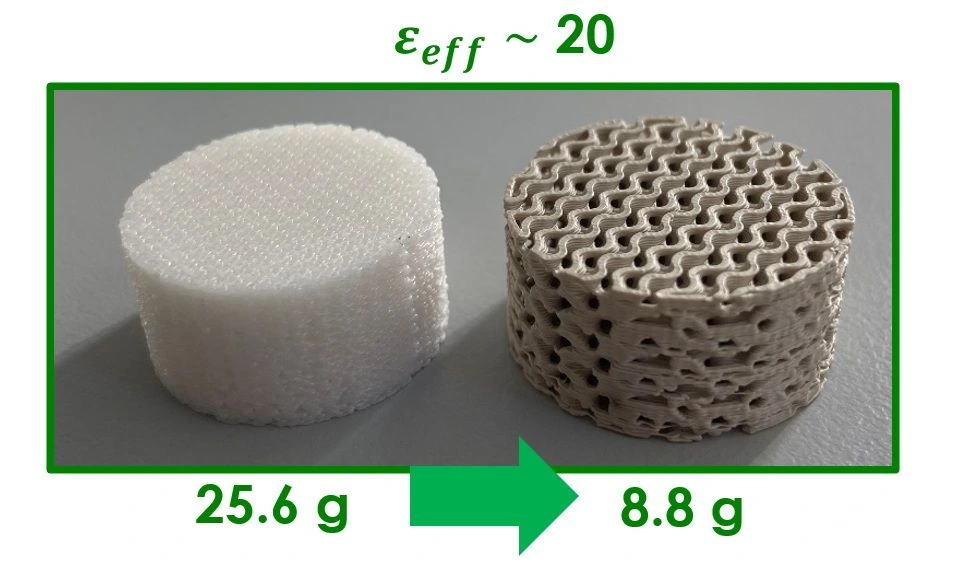
The ε=75 is characteristic of fully dense rutile TiO2. Variations in sintering density or the use of composite designs can modify effective permittivity for specific applications
- Brand Zetamix by Nanoe
- Printing Materials Metal Filaments
- Technology FFF
- Chemical symbol TiO2
- Sintering type Solid State Sintering
- Printing temperature 140°C
- Sintering Temperature 1300°C, under air
- Shrinkage 18.97% ± 1% (x, y) 20.44% in z
- Density 98-99%
- Specific Gravity [g.cm-3 ] 2.59
Videos