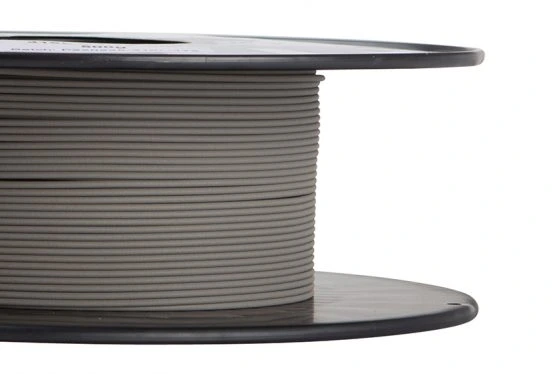
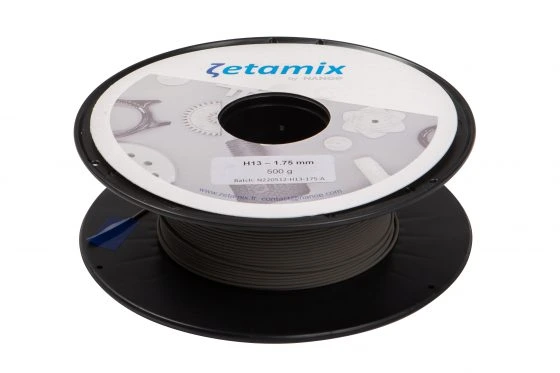
Zetamix H13 Tool Steel Filament 1,75mm
$390
Print FDM tooling → sinter into high-temp resistant molds, extrusion dies & durable industrial tools.
-
Compatible platform:
FFF
-
Type:
Metal Filaments
-
Categories:
Materials, Composite Tooling, Engineering, FFF(FDM), Filaments, Jigs&Fixtures, Manufacturing, Metal Filament
- Description
- Details
- Materials
- Documents
- Videos
- Review
Description
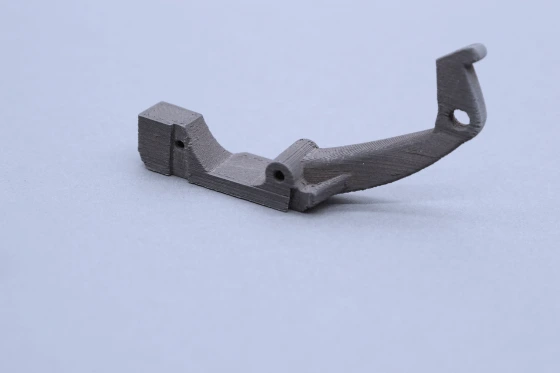
Zetamix H13 Tool Steel Filament enables direct manufacturing of high-performance tooling components using standard FDM 3D printers. Create complex injection molds, extrusion dies, and hot work tools with material properties approaching traditional H13 steel—bypassing costly machining and lead times for critical tooling applications.
Why Tooling Engineers & Manufacturers Choose Zetamix H13
High-Temperature Performance
Maintains strength and hardness at elevated temperatures
Ideal for injection molds, extrusion dies, and hot work applications
Excellent thermal conductivity for efficient heat management
Resistance to thermal fatigue and cracking
Complex Geometry Capability
Create conformal cooling channels impossible with machining
Manufacture intricate mold textures and features
Produce replacement tooling components on-demand
Scale: 118.2% (X/Y) and 119.6% (Z) for sintering compensation
Tooling-Grade Material Properties
90-91% density after sintering for near-wrought performance
High ductility reduces risk of brittle fracture in tooling applications
Corrosion resistance for extended tool life
X40CrMoV5-1 composition (90% steel by mass)
Material Properties After Sintering
Density: 90-91% of theoretical density
Temperature Resistance: Excellent for hot work applications
Ductility: High impact resistance for durable tooling
Thermal Conductivity: Efficient heat dissipation
Your Path to Advanced Tool Manufacturing
1. Design for Tooling Performance
Maximum printed size: 200mm (100mm recommended)
Minimum wall thickness: 1mm | Minimum pin diameter: 3mm
Minimum unsupported overhang: 35° | Minimum hole size: 1.5mm
Avoid abrupt size changes; use rounded corners for stress reduction
2. Precision Printing Requirements
Critical: Maintain ambient temperature below 25°C (air conditioning required)
Use grooved drive gears to prevent filament grinding
No retraction recommended for consistent extrusion
3 wall layers minimum with 20-100% infill density
100% fan speed from second layer for optimal quality
3. Thermal Processing
Thermal Debinding: 10°C/h ramp from 50°C to 650°C in Ar/H₂ atmosphere
Sintering: 50°C/h to 1350°C with 2h hold in controlled atmosphere
Atmosphere Control: 0.5 LPM flow at 0.2 bar pressure
FAQs
What makes H13 steel suitable for tooling applications?
H13 maintains strength at high temperatures (500°C+), offers excellent thermal fatigue resistance, and has good toughness—making it ideal for injection molds, extrusion dies, and hot work tooling.
What special printing environment is required?
The printing room must not exceed 25°C. If ambient temperatures are higher, air conditioning is mandatory to ensure successful prints.
How do the mechanical properties compare to traditional H13?
Sintered parts achieve 90-91% density with high temperature resistance and ductility suitable for functional tooling applications, though slightly below wrought H13 due to porosity.
What safety precautions are necessary?
Use in well-ventilated areas, wear FFP2 masks and safety glasses. The filament contains phenol (<5%)—avoid skin contact and inhalation of fumes during printing.
Can I create injection molds with conformal cooling channels?
Yes! This is a key advantage—create complex internal cooling channels impossible with traditional machining to significantly reduce cycle times.
What design limitations should I consider?
Maximum printed size: 200mm, minimum wall: 1mm, minimum feature: 1.5mm. Follow design guide recommendations for successful sintering.
How long does the complete process take?
Printing varies by model. Thermal debinding takes approximately 60 hours, and sintering requires about 28 hours including ramp times and holding.
What applications is H13 best suited for?
Injection molds, extrusion dies, hot stamps, forging dies, and any tooling requiring high temperature resistance, durability, and complex geometries.
Is chemical debinding required?
No—H13 uses thermal debinding only, simplifying the process compared to other metal filaments.
What's the shelf life and storage requirements?
One-year shelf life when stored in original vacuum-sealed packaging in cool, dry conditions below 25°C.
- Brand Zetamix by Nanoe
- Printing Materials Metal Filaments
- Technology FFF
- Other designation X40CrMoV5-1
- Sintering type Solid State Sintering
- Printing temperature 180°C – 190°C
- Sintering Temperature 1350°C under Ar/H2 (97.5/2.5) gas
- Shrinkage ≈ 17%. The values depend on the batch number you can read on the spool. Please refer to the guidelines to find the correct values for the batch you have.
- Density 90-91%
- Specific Gravity [g.cm-3 ] 4.5
- Melt Flow Rate [g/10(min)] (180°C - 875g – half die) 3.5
- Melt Volume Rate [cm3 /10(min)] ( 180°C - 875g – half die) 0.8
- Moisture Absorption , 7 days [%] <0,3%
- Moisture Absorption 24 hours [%] <0,1%
- Shore D hardness 50
Documents
Videos